

A while back we helped a woman whose husband needed memory care right before her own heart surgery. The community they chose ran close to $10,000 a month. Their income alone didn't come close, and the house that would pay for it hadn't sold yet. They got through it, but only because they found out the real number early enough to plan around it.
So, how much does memory care cost? In Oregon, the typical move-in cost in 2025 was about $8,190 a month, according to A Place for Mom's 2026 cost report. That's roughly $98,000 a year. Your parent's actual bill can land well above or below that, and the reasons why matter more than the average.
The Short Answer: What Memory Care Costs in Oregon in 2026
Here's how memory care compares with the other options families usually weigh. These are statewide medians, so treat them as a starting point, not a quote.
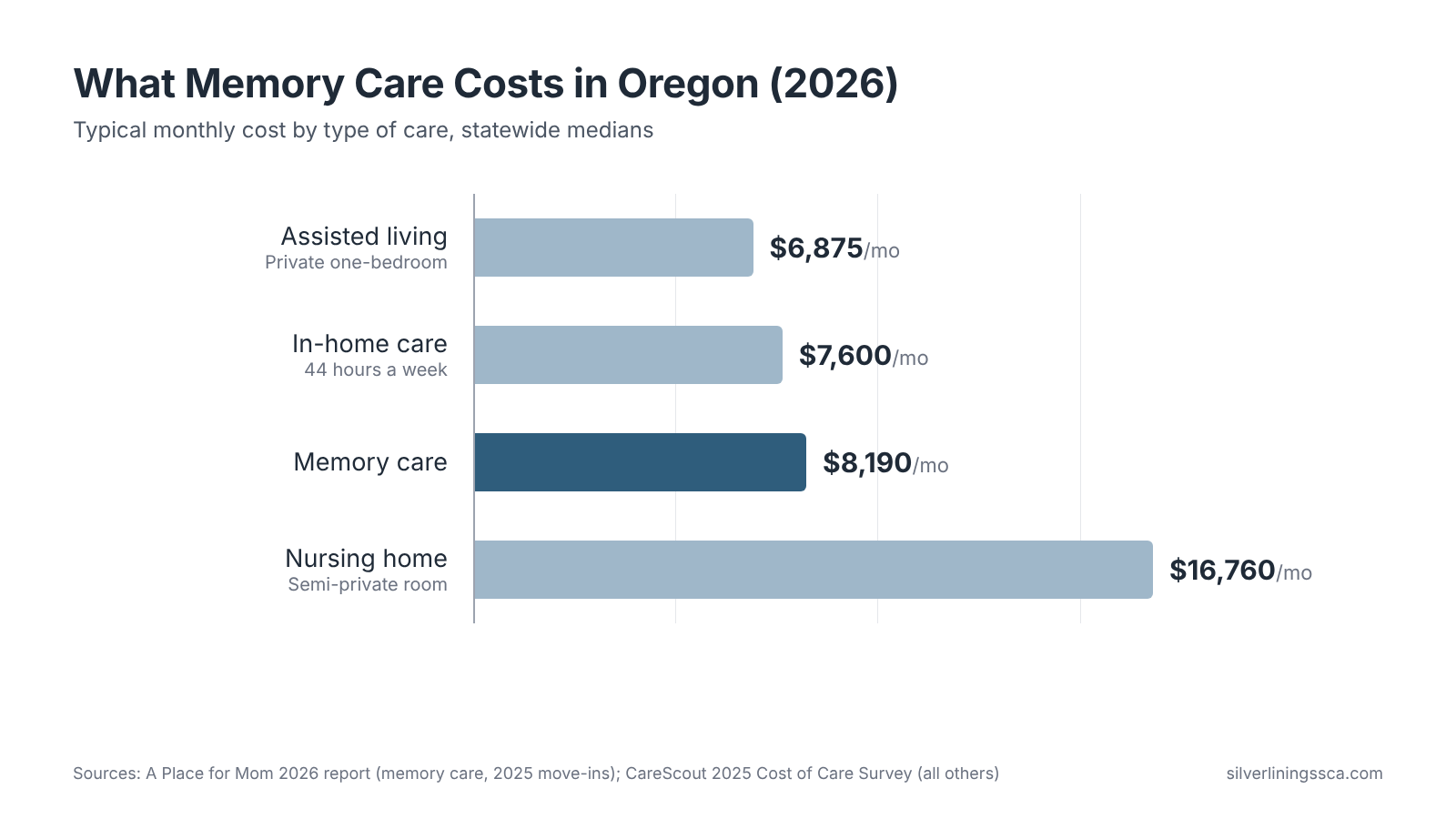
Sources: CareScout 2025 Cost of Care Survey for Oregon; A Place for Mom via Stacker.
Memory care in Oregon runs about 22% more than assisted living. Where your parent lives inside the state changes things too. Central Oregon and the Portland area tend to run higher than the mid-Willamette Valley.
Why One Community Costs $7,000 and Another Costs $11,000
The number on the brochure is almost never the number on the bill. What actually sets the price is the care assessment.
Before move-in, a nurse or care coordinator from the community evaluates your parent: how much help they need with bathing, dressing, toileting, eating and transfers, plus medications, mobility and behaviors. That assessment puts them into a care level, and the care level sets the monthly fee.
Chantelle Bellock, co-founder of Silver Linings, explains it this way: every community builds its pricing differently. Some use six or seven care levels. Some have only two or three. Others price everything à la carte, where each added service can be several hundred dollars a month on its own. Two communities with the same base rent can end up thousands apart once the assessment is done.
And it doesn't stop at move-in. "No matter what state I've been to, every place does it pretty much the same," Chantelle says. There's a reassessment around 30 days in, and then regular reviews after that, often monthly for the first few months or every quarter. Most people need more help after the move than the first assessment showed, so the bill tends to go up, not down. Our page on how care assessments work walks through what's evaluated and how to advocate for your parent during one.
A few things families should ask about up front:
The community fee. A one-time move-in charge. A Place for Mom puts the Oregon median for memory care at about $2,500.
What's all-inclusive and what isn't. Standalone memory care communities often bundle care into one rate. Communities with a memory care wing inside assisted living are more likely to bill by level.
Annual increases. Ask what the last two years of rate increases looked like.
Outside providers. When hospice gets involved, coordination takes staff time. One care home Chantelle worked with quoted an extra $1,500 a month for exactly that reason. She hadn't run into that charge before, which is exactly why it's worth asking.
Supplies. Incontinence products and personal items are often billed separately.
Is Memory Care Cheaper Than Keeping Mom at Home?
Usually not once she needs real supervision, and this is the comparison families most often get wrong.
In-home care in Oregon generally runs around $40 to $50 an hour, and most agencies have a four-hour daily minimum. Four hours a day is already about $6,000 a month. But someone living with moderate dementia rarely needs four hours of help.